The Most Valuable Data in an AI Report May Be the Human Corrections

Yang Li
Founder, ExcelDashboard AI
Published10 min read
AI data reporting is getting very good at producing a first draft. Upload a spreadsheet, connect a data source, ask a question, and an AI data agent can increasingly analyze the numbers, create charts, explain what changed, and turn the result into a polished business report. For the past few years, we have been working on this problem from a slightly different direction.
Our goal with ExcelDashboard AI has been to make automated reporting useful enough for real work: AI creates the analysis and report draft, then a business user reviews it, corrects what is wrong, and decides what is actually worth delivering to a client or leadership team. At first, we treated that human review as a temporary limitation. Better AI models should mean fewer corrections. Fewer corrections should mean less review. Eventually, perhaps, the AI reporting agent should simply get everything right.
We are starting to think that assumption may be wrong. Because in business reporting, human corrections may be one of the most valuable sources of data an AI agent can receive.
01
Not Every AI Reporting Error Is a Model Error
Imagine an AI report generator creates a monthly performance report. A business user opens it and says:
Remove this chart.
Then:
Revenue should not be calculated this way.
Then:
A 4% decline is not meaningful for us. It should not be in the executive summary.
Finally, they change:
“Customer acquisition deteriorated significantly.”
to:
“Paid acquisition softened slightly, but remains within our expected range.”
At first glance, these all look like failures of AI data analysis. The obvious reaction is:
The model needs to become more accurate.
But these corrections actually contain several different kinds of information. Some are genuine analytical mistakes. Some are data-definition problems. Some reflect company-specific metric logic. Some contain management judgment.
Others encode reporting conventions that this particular business has developed over years. A stronger foundation model can eliminate some of these problems. But it cannot automatically know:
For this company, a 4% change usually does not deserve escalation.
And it cannot know:
The industry normally defines CAC one way, but this company has used a different internal definition for years.
That is not general business knowledge. It is not even purely industry knowledge. It is organizational knowledge. The kind of knowledge companies use every day but rarely document completely.
02
We Underestimated How Much Business Knowledge Lives Inside an Edit
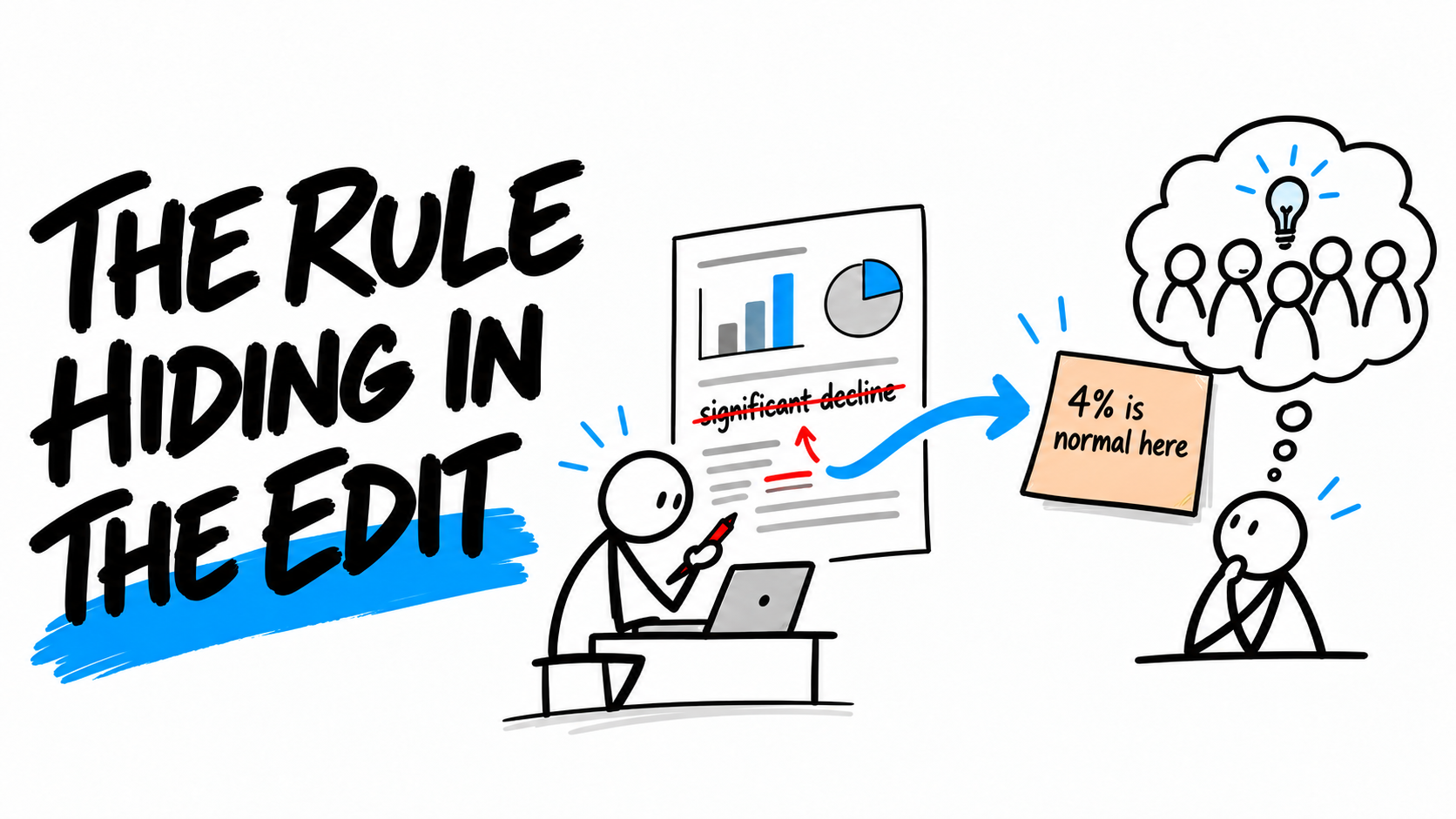
After working on AI data reporting for years, we have started noticing something interesting. Edits to a report are rarely just edits to the report. A real review process can reveal:
- which metric definition is considered canonical;
- which data source takes priority when systems disagree;
- what kind of anomaly deserves investigation;
- how large a change needs to be before it becomes meaningful;
- which metrics should never be compared directly;
- which conclusions require cautious language;
- which charts leadership routinely ignores;
- which sections a client expects every month;
- which conclusions should always remain human decisions.
Much of this information does not exist in the database schema. It may not exist in a company knowledge base either. Often, it exists only in the head of an experienced analyst, operator, account manager, or founder. And it gets revealed through a tiny comment:
“Don’t write it like that.”
That changes how we think about human-in-the-loop AI. Human review may not simply be:
AI does the work. Humans catch the mistakes.
It may also be:
Humans continuously expose the real operating rules of an organization to the AI reporting agent.
That is a very different role.
03
The Worst AI Agent Experience May Be Making the Same Mistake Twice
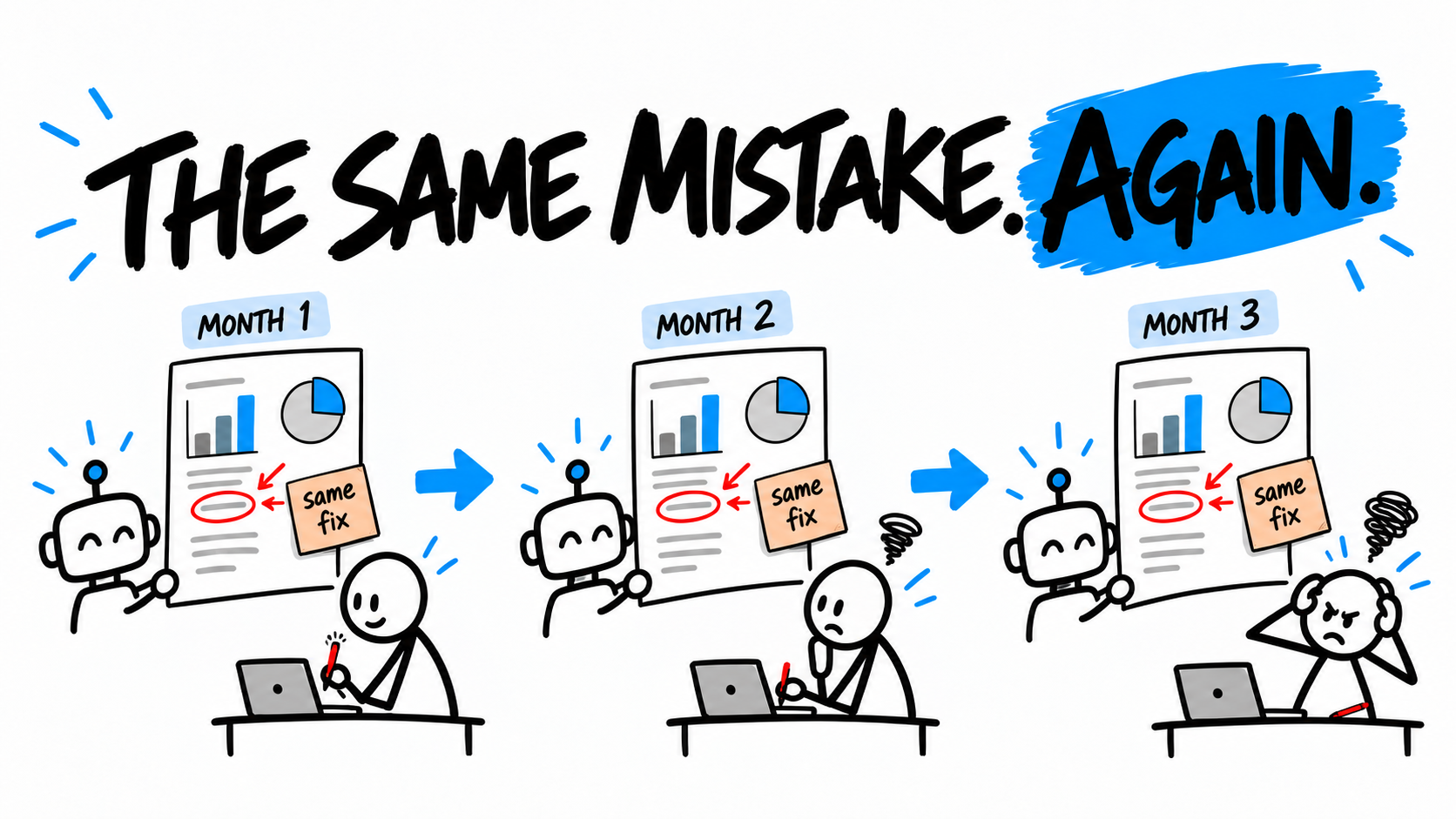
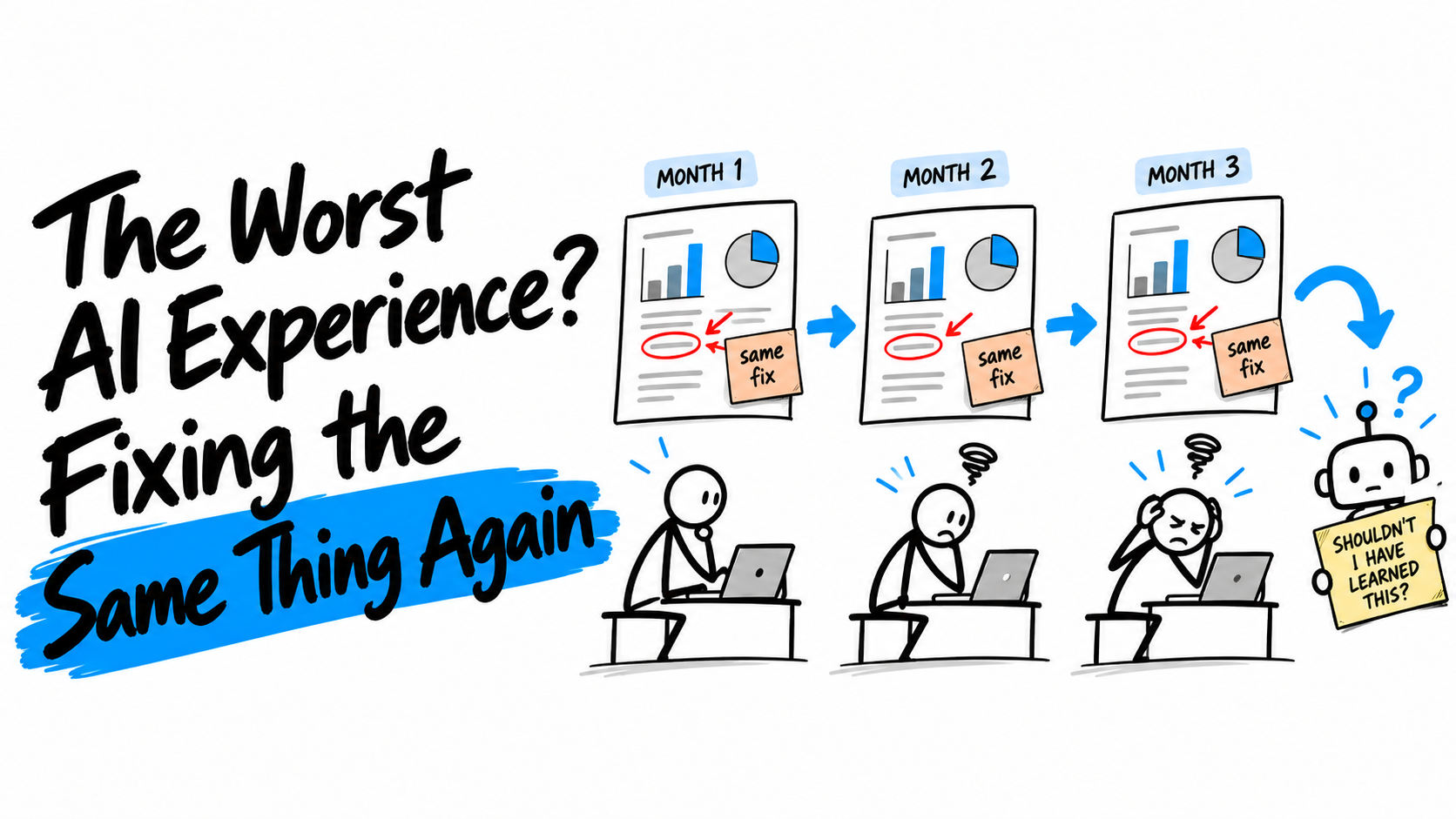
Suppose an AI reporting agent is producing its first monthly report for a SaaS company. It does not know that this company counts only paying users as “Active Customers.” The user corrects it. That is understandable. The real problem begins next month.
New data arrives. The automated reporting workflow runs again. The agent includes all users again. The human fixes it again. And then it happens again the month after that.
At that point, this is no longer just an AI accuracy problem. The product is demonstrating something more fundamental:
It is not learning how the company works.
We think this is an underestimated weakness in many AI workflow products. Each individual AI conversation can look intelligent. The analysis may be impressive. The charts may look professional. But very little accumulates at the product level.
The user repeatedly has to explain: context, definitions, preferences, constraints,
exceptions, and judgment. The AI behaves like an extremely capable analyst who is somehow on their first day at the company every month. So we have started asking a very simple question when evaluating an AI reporting agent:
Will the same human correction happen again next time?
If the answer is consistently yes, then the system may be automating report generation without truly automating the reporting process.
04
Industry Knowledge May Not Be the Most Durable Vertical AI Advantage
One common argument for Vertical AI is industry expertise. An e-commerce AI agent understands ROAS. A SaaS AI agent understands churn and retention. A finance AI agent understands financial metrics. That clearly matters.
But foundation models are rapidly getting better at this type of knowledge. Today, general AI systems can already explain most common business metrics and reason through many standard analytical frameworks. Over time, that knowledge will become even easier to access. This makes us increasingly skeptical that simply building a larger industry knowledge base will create a durable advantage for an AI data product. The harder knowledge may be much smaller and much stranger:
We exclude this revenue category.
This source is unreliable before the third day of every month.
This client never wants YoY comparisons.
This metric looks bad, but it is seasonal, so do not escalate it.
The CEO removes this slide every month.
These rules are difficult to learn from public documentation. They emerge through actual work. Through review. Through disagreement. Through correction.
That has led us to a hypothesis we find increasingly useful:
The moat may not be what the model knows. It may be what the product learns from being corrected.
General AI knowledge will continue to become cheaper. Company-specific corrections are different. Six months of real reporting history with one organization contains context that cannot simply be downloaded from the internet.
05
Human Review May Be the Learning Interface of an AI Reporting Agent
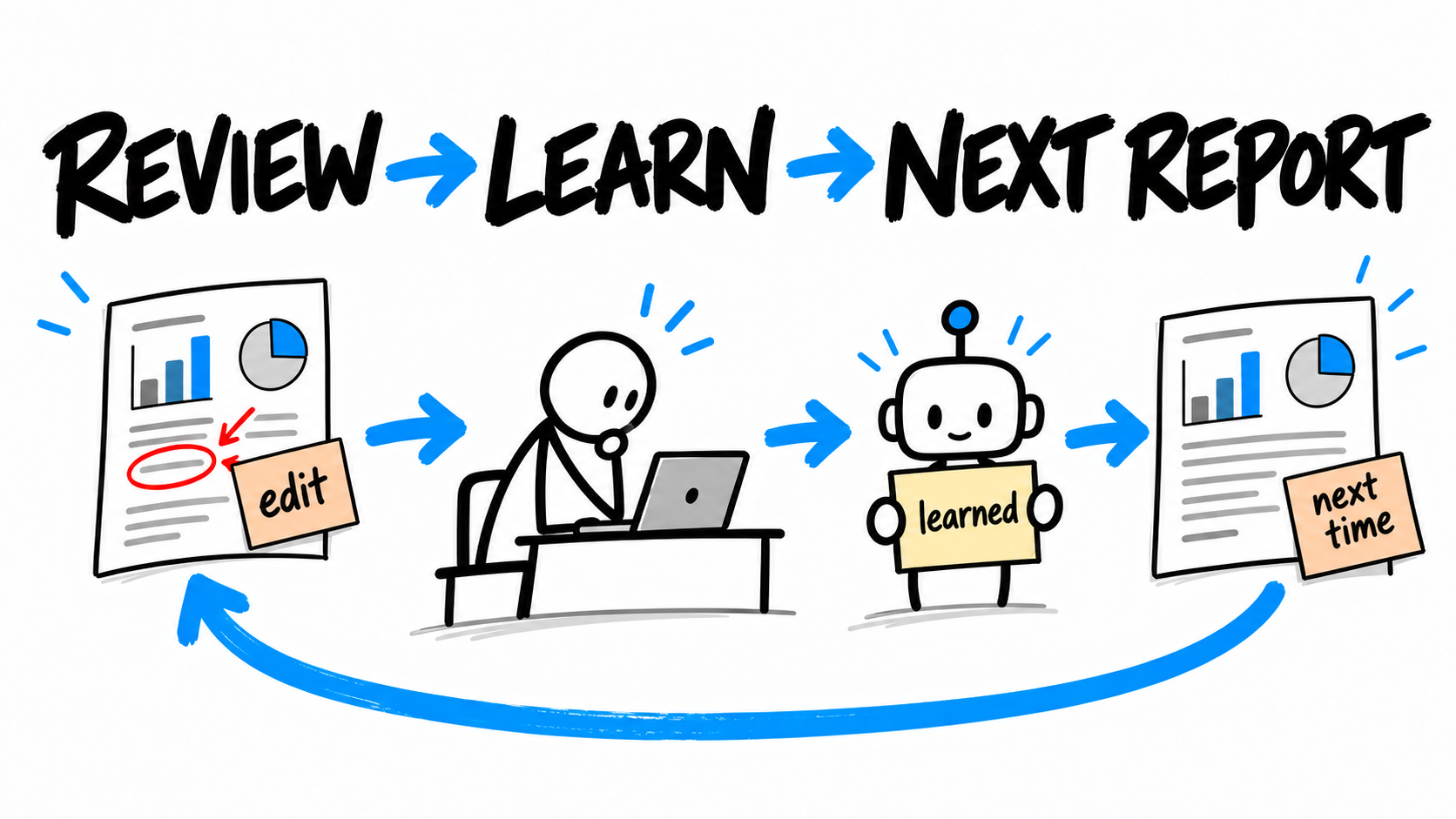
This also changes how we think about automated reporting workflow design. A typical AI report generator looks something like this:
Data → AI Analysis → Report → Human Review → Export
Review is the final checkpoint. But an AI reporting agent that improves over time should probably look more like:
Data → AI Analysis → Report → Human Review → Learn → Next Reporting Cycle
The difference is small on the first report. Over time, it becomes enormous. If a user deletes a chart, should the system treat that as a one-time edit? Or should it learn that this chart is rarely useful for this client? If a user changes a metric definition, is that a temporary correction?
Or should it become part of the company's canonical reporting logic? If “significant decline” is repeatedly rewritten as “slight decline,” can the agent learn how this business interprets significance? If an analyst manually adds the same calculation every month, should that analysis become part of the default reporting workflow? This creates a much harder product problem than simply generating another chart:
How do we turn human edits into reusable, structured company knowledge?
The edit itself is easy to save. Understanding what that edit means is harder. Was it correcting a fact? Changing a metric? Expressing a preference?
Applying a business rule? Making a one-time exception? These distinctions matter because the agent should not blindly memorize everything either. A good AI data agent needs to decide what should persist and what should not.
06
Maybe AI Reporting Needs a New Metric: Repeated Correction Rate
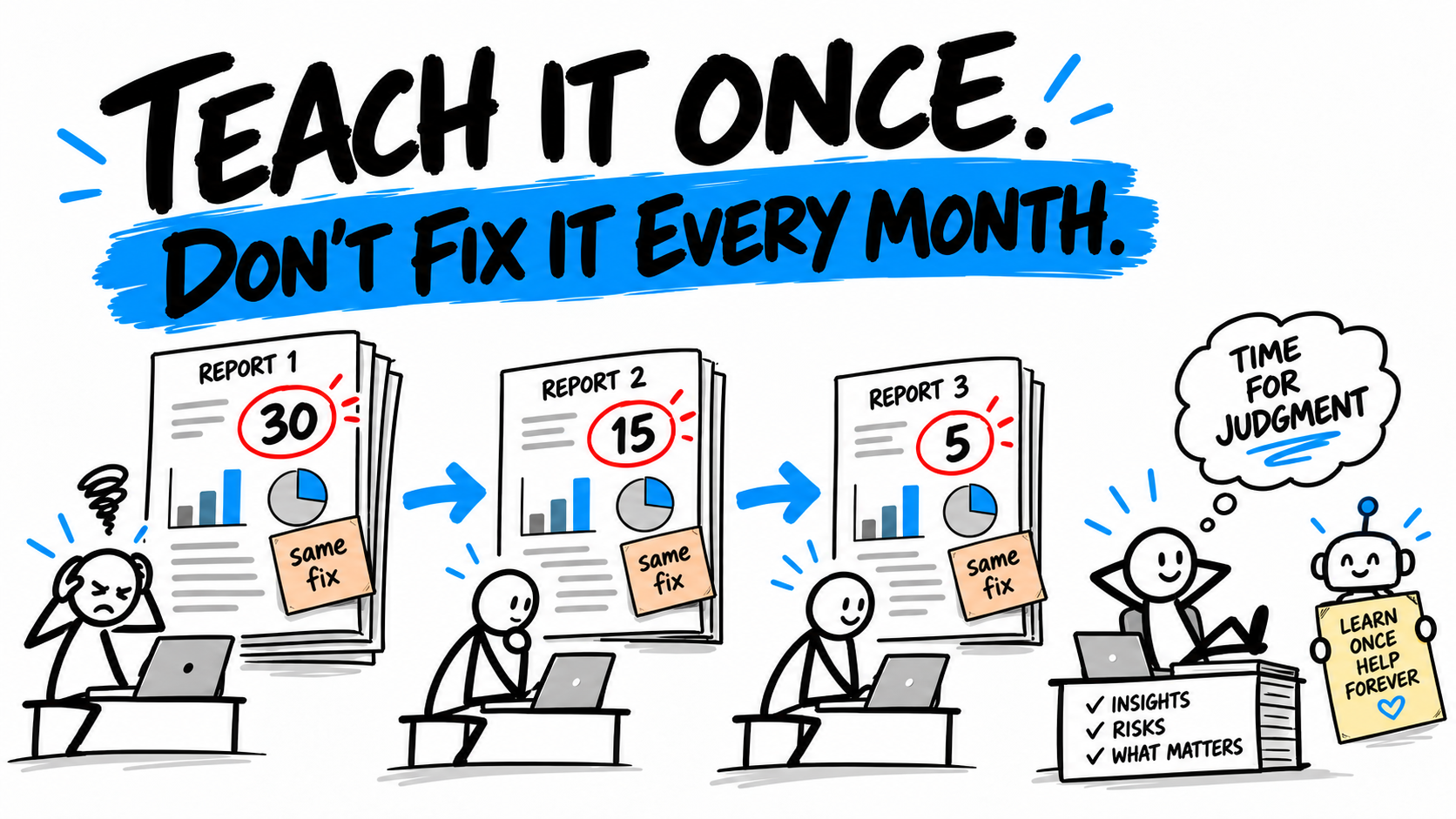
AI products are often measured using metrics such as: accuracy, task completion, latency, and user satisfaction.
All of those matter. But for recurring data reporting automation, we think another set of metrics could be useful.
Repeated Correction Rate
How often does the same class of error need to be corrected across multiple reporting cycles?
Context Repetition Rate
How often does the user have to explain something the system has already been told?
Review Reduction
As the AI reporting agent is used over time, does the amount of human editing required for the same recurring report actually decline? Imagine the first AI-generated report requires 30 corrections. Three months later, the same reporting workflow still requires roughly the same 30 corrections. The underlying model may have become stronger. But the product itself has not learned very much.
Now imagine something different. The first report requires 30 corrections. The second requires 15. After several reporting cycles, only five issues remain—and those five require genuine human judgment. That begins to look like something much more interesting than an AI report generator.
It looks like a system learning how an organization works. Perhaps the goal of human-in-the-loop reporting should not be:
Human review → 0
It should be:
Repeated human correction → 0
Humans may still be responsible for judgment. They should not have to teach the AI the same lesson every month.
07
OpenAI’s Data Agent Makes This Problem More Visible
OpenAI encountered a related issue while building its own internal Data Agent. The system does not rely only on the reasoning ability of the model. OpenAI describes multiple layers of context, including human annotations, institutional knowledge, and memory. When users correct the agent or it discovers non-obvious rules, those learnings can be preserved so future analysis starts from a better baseline rather than repeating the same mistakes. That is important.
It suggests that even as AI data analysis becomes dramatically more capable, context accumulation remains a core problem for enterprise AI agents. For data reporting, we think this idea can go one step further. The system should not only remember:
This table needs this filter.
Over time, it should start understanding:
This is how this organization decides what a good report looks like.
That includes data rules. It includes business judgment. It includes communication preferences. And it includes the habits of the humans responsible for reviewing and delivering the final report.
08
This Is Changing How We Think About ExcelDashboard AI
Over the years, we have spent a lot of time thinking about the visible parts of AI reporting. How do we make AI data analysis more accurate? How do we create better charts? How do we generate truly editable PowerPoint reports? How do we make the evidence behind an AI-generated insight easier to verify?
Those problems still matter. But we are adding another question:
When a user edits an AI-generated report, what exactly did the system learn?
If the answer is:
Nothing. We will regenerate everything from scratch next month.
Then we have placed human review after AI generation. We have not really eliminated repetitive reporting work. But if an AI reporting agent can gradually transform those corrections into: company metric definitions, reporting principles,
analysis preferences, anomaly thresholds, review rules, client-specific requirements, and reusable reporting context,
then every human review does more than improve the current report. It improves the next one. That may be one of the most important differences between an AI report generator and a true AI reporting agent. The first produces an output. The second should gradually learn how the organization works.
Foundation models will keep getting stronger. AI data analysis will keep getting cheaper. Industry knowledge will become easier to access. But the way one company actually interprets its data, reviews its reports, and makes decisions may only be learnable through the work itself. So we have started asking one simple question:
When a human corrects the agent, does the product just fix the report—or does it learn how the company works?
The most valuable thing an AI reporting system accumulates may not be another dataset. It may be the rules hidden inside those corrections.